

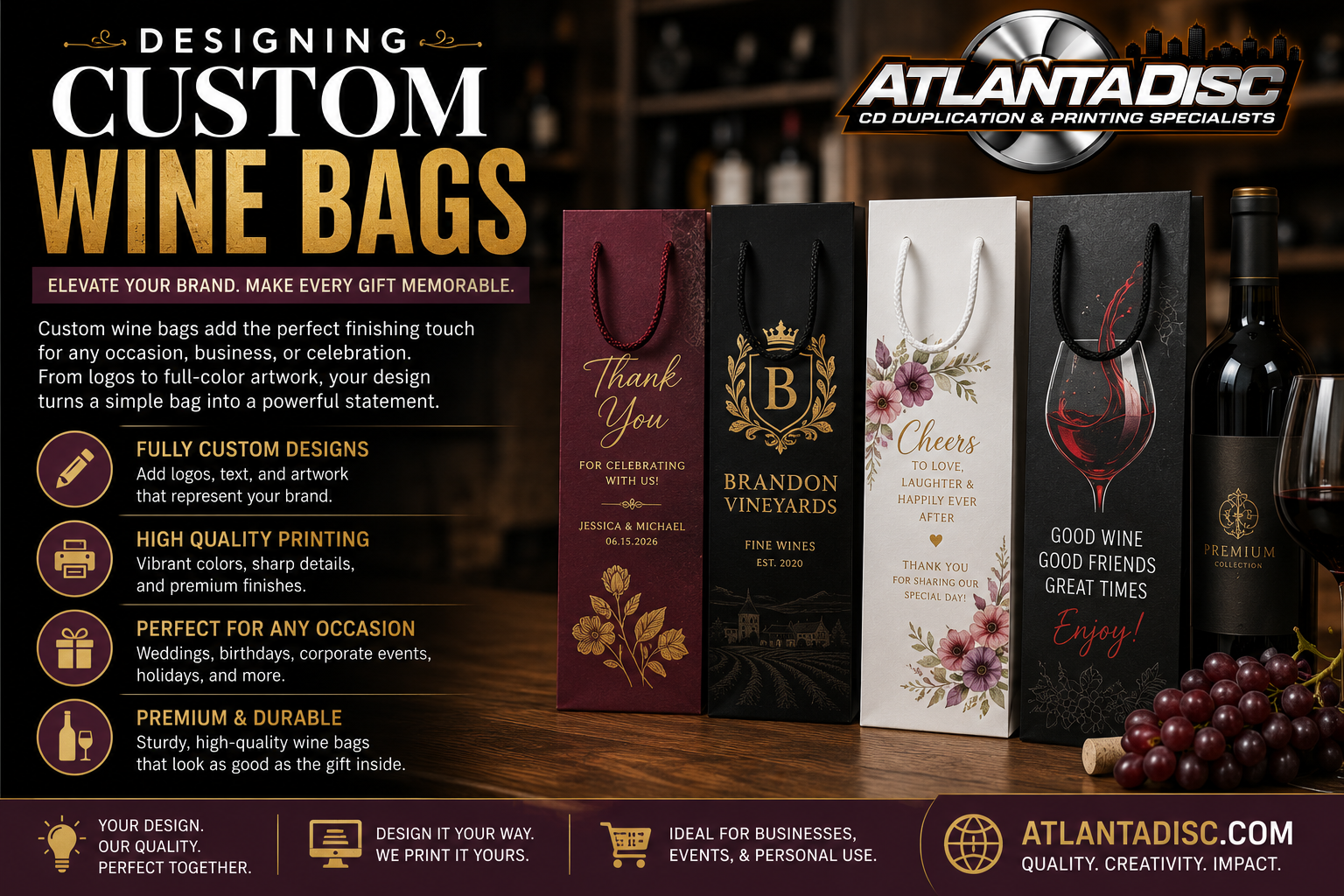
You’re probably not shopping for custom wine bags because you woke up passionate about gussets and fabric weights. You’re doing it because you’ve got a release party, a winery date, a VIP bundle, a sponsor drop, or a merch concept that needs to feel more thoughtful than stuffing a bottle into a plain gift sack.
That’s where most projects go right or wrong. A good custom wine bag feels like part of the brand. A bad one feels like an afterthought, or worse, it fails when someone picks it up by the handles. For musicians, artists, and indie labels, the bag has to do two jobs at once. It has to carry glass safely, and it has to look like merch somebody wants to keep.
Custom wine bags exist within a commercial world far larger than commonly perceived. The global wine market was valued at about US$340 billion in 2023, and is projected to reach roughly US$456 billion by 2032, with an implied 3.6% compound annual growth rate during 2024 to 2032, according to Bagz Depot’s custom wine bag market overview. That matters because presentation isn’t some tiny niche concern. In a market this large, packaging has real weight in gifting, retail, and branded experiences.
Choosing the Right Custom Wine Bag Material
A bottle bag that looks right on the mockup can still fail at the merch table. Handles dig into hands. Corners soften. Print loses contrast. The material choice decides a lot of that before anyone talks ink colors.
For musicians, artists, and indie labels, I usually sort materials by use case first. Is this bag meant for a one-night release event, a VIP add-on, a winery collab, or a piece of merch people will reuse? That answer narrows the field fast and keeps you from paying canvas money for a throwaway handoff.

Paper for short-term presentation
Paper works best for controlled settings. Press drops, seated dinners, label launch parties, and guest gifts where the bottle goes from table to car without much abuse.
It gives you a clean print surface and a polished look in photos. If the event has soft lighting, good styling, and a short carry distance, paper can look better than a cheap fabric bag.
The trade-off is durability. If guests are walking a festival lot, standing in a merch line, or leaving in bad weather, paper becomes a risk. I would not use it for outdoor activations or anything meant to feel like lasting merch.
Non-woven polypropylene for bulk runs
Non-woven polypropylene, or NWPP, is often the practical middle ground. It keeps costs under control, holds up better than paper, and works well for larger orders where the bag needs to do its job without eating the whole budget.
That makes it useful for sponsor gifts, tasting events, venue partnerships, and larger fan bundles. It reads more promotional than premium, but that is not always a problem. For a lot of indie projects, getting a sturdy bag at the right price is the smarter call than chasing a luxury feel nobody asked for.
For heavier multi-bottle builds, fabric weight matters. Commercial models often use 80 GSM non-woven polypropylene with sewn-in dividers, while premium versions use 100 GSM fabric, according to WineBags.com tote bag specifications. In production terms, that affects how secure the bag feels once full. If you are packing two bottles for a VIP bundle, that extra structure is worth pricing early.
Practical rule: For two-bottle or divider bags, check fabric weight, stitching, and handle attachment before you approve a quote.
Cotton and canvas when the bag is part of the merch
Cotton and canvas make sense when the bag has life after the bottle is gone. Fans reuse them. Artists can sell them. Labels can fold them into premium bundles without the bag feeling disposable.
That is why these materials work well for album launches, membership drops, and higher-ticket packages. They feel closer to apparel merch than event packaging, which helps if your brand already lives in tees, posters, and physical editions. A well-printed canvas wine bag can sit on a shelf next to the vinyl and still make sense.
The downside is unit cost. Cotton and canvas usually cost more, and the difference gets noticeable on larger runs. If the bag is only carrying one sponsored bottle for one evening, that spend may not come back to you.
Jute and insulated options for specific jobs
Jute has a rougher, more natural texture. It fits vineyard shows, acoustic sessions, farm dinner tie-ins, and brands that want an earthy or handmade feel. The texture is the appeal, but it also affects the print. Fine detail and small type usually read less crisply on jute than on smooth canvas.
Insulated bags solve a different problem. They help with temperature control and make sense for outdoor summer events, hospitality gifts, and premium wine pairings. They are bulkier, usually more expensive, and less merch-like in feel, so I only recommend them when the function is part of the pitch.
Here is the quick filter I use when estimating:
| Material | Best use | Strengths | Watch for |
|---|---|---|---|
| Paper | One-time gifting | Clean presentation, strong photo presence, easy print face | Weak against moisture and rough handling |
| NWPP | Bulk promotional runs | Lower cost, good durability, practical for events | More utilitarian look |
| Cotton/canvas | Reusable merch and VIP bundles | Better hand feel, stronger brand value, repeat use | Higher unit cost |
| Jute | Rustic or artisanal presentation | Distinct texture, memorable look | Less crisp print detail |
| Insulated | Temperature-sensitive gifting | Added protection and premium function | Bulk and price |
Minimums matter too. Many factories and wholesalers sell custom wine totes in production runs rather than tiny test orders, often starting in the low hundreds, as noted earlier. That is why material choice needs to happen up front. If you order a few hundred bags, the wrong substrate is not a small mistake. It is a stack of inventory you still have to hand out.
Branding and Printing Options for Your Design
A band finishes a small run of VIP bottles for an album release. The wine is good, the label looks sharp, but the bag is what fans carry through the venue and post afterward. If that print looks cheap, off-center, or overdesigned, the whole package drops a notch.
That is why print method needs to match both the art and the way the bag will be used. A merch-table tote for repeated use needs a different approach than a one-night release party handout. I have seen one-color logos look expensive on the right stock, and I have seen detailed artwork fall apart because the bag surface could not hold the detail.

Match the print method to the artwork
For bold logos, clean symbols, and short text, screen printing is usually the first option to price. It holds solid shapes well, works nicely for one or two ink colors, and stays cost-effective on larger runs. For indie labels doing tour dates, anniversary drops, or bottle-and-shirt bundles, this is often the safest choice.
Digital printing or transfer-based decoration fits artwork with gradients, shading, or poster-style illustration. That includes album-cover adaptations and painted graphics that would be expensive or messy to separate for screen print. The trade-off is usually cost per unit, surface feel, and sometimes durability, depending on the bag material and the printer’s setup.
Heat transfer has its place on short runs and proof-of-concept orders. It can reproduce detail that a basic spot-color setup cannot. The risk is that some transfers sit on top of the fabric in a way that feels less premium, especially on soft cotton bags meant to read like real merch.
What works best for musicians, artists, and labels
Wine bags are narrow, vertical, and less forgiving than a tee or a poster. The designs that hold up best usually stay focused.
- Single front logo or symbol. Best for bands, labels, and artist marks that already have a strong identity.
- Release-specific graphic. Good for album launches, listening parties, and limited bottle bundles, but it usually needs simplification from the full poster art.
- Type-led layout. Artist name, label name, release title, or event date in a strong composition.
- Minimal premium look. One ink color on a better bag, often the smartest route for VIP gifting or higher-priced bundles.
I usually tell clients to treat the bag like a record spine, not a flyer. Clear read. Strong hierarchy. No clutter.
Placement matters too. Most custom wine bags print on the front and back panels, not across seams or folds, so centered art usually performs better than a wraparound concept. If you want a design to feel polished at a merch table, keep the main graphic inside the clean printable area and give it room away from the handle zone.
Here’s a good production walkthrough if you want to visualize how decorated bags move from blank stock to finished product:
Design for distance, not just for the proof
The proof is flat and clean. Real life is different. Bags crease, swing, get stuffed under tables, and end up in low light at venues.
That changes what reads well.
Small text near the bottom panel often gets lost. Fine lines near a fold can break visually. Dense layouts may look good on a screen and still feel cramped once the bottle is inside. If the bag is part of a fan-facing package, the front panel should still read from a few feet away.
A simple hierarchy helps:
- Put the main brand element first.
- Keep secondary copy short.
- Avoid stacking too many logos or social handles.
- Leave margin around the top edge and handles.
If the goal is reuse, make the bag look like something a fan would carry after the event. That usually means cleaner art, fewer words, and a print method that suits the material instead of fighting it.
Sizing Your Bags for the Perfect Fit
A bag can look right on a proof and still fail the first time someone drops a bottle into it at a merch table. The usual problems are easy to spot in person. The base rounds out, the side panels pull hard, the bottle neck sits too high, or the handles feel sketchy before anyone leaves the room.
For wine bags custom runs, fit starts with the actual bottle you plan to pack. Height matters, but width and depth usually decide whether the bag feels clean and intentional or cramped and underbuilt.
Start with the bottle, not the template
Standard single-bottle bags are generally built around a typical 750 ml wine bottle. That gets you into the right range, but “standard” only helps if your bottle is standard. Many artist collabs, private-label releases, and sponsor bottles are not.
I always tell clients to check three things before approving size:
- Body diameter at the widest point
- Overall bottle height, including foil or wax top
- Any extras inside the bag, such as tissue, neck tags, postcard inserts, or small merch items
Those extras matter. A bottle that fits fine on its own can become a tight, awkward load once you add a folded one-sheet, VIP note, or branded wrap.
The gusset decides how the bag carries
If one measurement gets overlooked, it’s the gusset. That’s the depth that lets the bottle settle into the bag instead of forcing the front and back panels outward.
A shallow gusset creates two common problems. The bottle drags going in, and the printed panel distorts once the weight hits the bottom. For an indie label or artist using these in fan packages, that distortion shows up fast. The logo bows, the bag loses shape, and the whole piece feels cheaper than it should.
A little extra room is usually the safer call, especially if the bag is part of a premium drop.
Common fit calls by use case
Different use cases need different tolerances. A wine bag handed to a radio contact backstage has one job. A bag sold as part of a VIP bundle has to survive transport, photos, and reuse.
| Use case | Best bag format | What to check |
|---|---|---|
| Artist gift or media drop | Single bottle | Gusset depth and panel width |
| Fan VIP package | One or two bottles | Extra room for tags or inserts |
| Winery show merch | Single reusable tote | Comfortable carry and repeat use |
| Label sampler or sponsor set | Multi-bottle tote | Divider construction and material strength |
That last row matters more than people expect. Multi-bottle bags are less forgiving because weight shifts during carry. If the package includes two bottles, or bottles plus other items, ask about reinforced bottoms and dividers. Without them, bottles knock together and the bag swings badly.
Odd bottle shapes change the job
Magnums, squat sparkling bottles, broad-shouldered reds, and wax-dipped releases need their own fit check. The height may look fine on paper, but the shoulders can catch halfway down, or the base can be too wide to sit flat.
This comes up a lot with special-release packaging. A musician or label will source a bottle that looks great for a launch event, then choose a stock bag based on height alone. That usually leads to a rushed change after samples arrive.
Avoid that step if you can. Test with the actual bottle.
If the order matters to presentation, send your printer one physical bottle or provide exact packed dimensions. A digital mockup cannot show how the bottle drops, where it rubs, or whether the bag keeps its shape once loaded.
A practical sizing rule
Choose the smallest bag that still loads easily, stands cleanly, and leaves room for planned inserts. Too tight looks strained. Too loose looks generic and lets the bottle shift.
For merch, VIP gifting, and label drops, the best fit usually feels deliberate without looking engineered. The bottle goes in without a fight. The front panel stays readable. The fan or guest can carry it one-handed without worrying about the bottom giving out.
Preparing Your Artwork for Flawless Printing
Most delays in custom bag production don’t start at the press. They start with artwork that looked fine on a laptop and falls apart the minute a printer opens it.
That doesn’t mean you need to be a prepress technician. It means you need to send files that won’t trigger preventable back-and-forth.
The five things that save the job

A clean file package usually comes down to five checks:
- Use vector art when possible
AI, EPS, and press-ready PDF files are the safest starting point for logos and text-based designs. They scale cleanly and give the printer control without introducing jagged edges.
- Outline your fonts
If the printer doesn’t have the exact typeface installed, your design can reflow, substitute, or break. Outlining turns the text into shapes so the file behaves predictably.
- Build in CMYK, not RGB
Screen color and print color aren’t the same environment. If your art was built for digital display only, expect shifts when it moves to ink.
- Include bleed if the design runs to the edge
If color or artwork extends to the trim, the file needs extra image area beyond the cut line. Without it, you risk thin white edges after trimming.
- Check line weight and small detail
Fine details can disappear on textured material or narrow print areas. If the logo has tiny type or hairline strokes, simplify before approval.
Common mistakes from creative teams
Artists often send great-looking source art in the wrong format. The usual problems aren’t about taste. They’re technical.
- Low-resolution JPEGs pulled from social posts
- Canva exports without print setup
- Fonts left live
- Black built inconsistently across files
- Artwork sized for a square flyer, not a vertical bag panel
Those aren’t disasters. They just create extra rounds.
Send the original working file, not just the preview export. The preview shows what you saw. The working file shows what can actually be printed.
A fast preflight routine
Before you upload anything, run this quick check:
| Check | Good sign | Red flag |
|---|---|---|
| File format | AI, EPS, or print PDF | Screenshot or compressed JPG |
| Fonts | Outlined | Missing font package |
| Color mode | CMYK-ready art | RGB-only design |
| Layout | Sized to bag panel | Generic square artboard |
| Edge treatment | Bleed included if needed | Art stops exactly at trim |
One more thing matters with wine bags custom jobs. Narrow products exaggerate alignment issues. A design that’s slightly off-center on a broad tote may still look fine. On a wine bag, even a small shift can look more obvious because the printable face is compact and vertical.
That’s why proofing isn’t a formality. Read the proof, check the dimensions, and make sure the art sits where you think it does.
Creative Use Cases for Musicians and Labels
A fan walks up to the merch table after a winery set, buys a record, and asks if there is anything special besides the usual tee and poster. That is the moment a custom wine bag earns its keep. In the music world, it works best as merch packaging, a collectible add-on, or a VIP piece that feels tied to the release, not like leftover corporate promo.
Winery gigs and event merch
Winery shows are the clearest fit, but the bag still has to make sense for the room. If the venue already sells bottles, a printed wine bag gives you an easy upsell at the table. If the venue allows artist-branded pairings or signed bottles, the bag turns that purchase into something giftable and easier to carry.
The practical advantage is simple. A bottle on its own feels like concession merchandise. A bottle in a well-printed bag feels like part of the event. That difference matters if you are trying to raise per-head merch revenue without hauling another box of shirts in six sizes.
VIP drops that feel complete
For indie artists and small labels, VIP packages often live or die on presentation. The items may be strong, but if everything arrives as a loose stack in a mailer, the package feels improvised. A custom wine bag gives the bundle structure.
A release package can include:
- A signed bottle in a printed bag
- Vinyl or CD
- A lyric sheet, thank-you note, or short run art print
- A ticket, laminate, or access pass for a listening party
That setup works especially well for acoustic releases, anniversary editions, label showcases, and crowdfunding rewards. The bag becomes part of the memory of the campaign, not just the wrapper around one bottle.
Industry gifting that still feels on-brand
Managers, labels, and artist teams also use wine bags for small industry gifts. The mistake is over-branding them. If the goal is to send something to a promoter, venue buyer, playlist contact, or collaborator, restraint usually gets a better result.
A clean cotton or non-woven bag with a small front mark, tour title, or label insignia has a much longer shelf life than a loud full-panel promo graphic. In print terms, that lighter approach also tends to age better. Trends shift fast. A simple mark tied to the artist identity stays usable after the campaign ends.
Good music merch feels considered before it feels promotional.
Limited-run merch that stands on its own
Some artists can sell the bag empty, and that only works if the design has enough character to live beyond the bottle. Fans who already buy totes, zines, slipmats, and other soft goods are usually open to that format, especially if the artwork feels like part of the album world.
The trade-off is usability. A wine bag is narrower and more specific than a standard tote, so it helps to position it clearly. Sell it as a bottle carrier, picnic accessory, dinner-party gift bag, or collectible tour item. That framing gives the customer a reason to keep using it instead of treating it like novelty merch.
For artists and labels, that is the true value. A custom wine bag can carry a bottle once, then keep showing up in kitchens, green rooms, and house gatherings long after the show is over.
Your Ordering Checklist Pricing and Timelines
A lot of wine bag orders get expensive before production even starts. The trouble usually begins at the quote stage, when an artist team asks for pricing with half the job still undecided.
For bands, labels, and artist managers, that usually looks familiar. One person wants a VIP bottle bag for a release party, another wants something sellable at the merch table, and nobody has confirmed bottle size, fabric, print method, or quantity. At that point, every quote is provisional, and provisional quotes are where budgets drift.
Treat the order like a real print job with a deadline and a use case.
Lock Down These Details First
Before you ask any supplier for pricing, get clear on five things:
- What the bag needs to do
Retail merch, a backstage gift, a sponsor drop, or a VIP add-on all push the spec in different directions.
- The bag format
Single-bottle, double-bottle, or a tote with extra room changes both cost and construction.
- Your preferred material
If you are undecided, narrow it to two options and describe the finish you want. Soft and premium feels different from durable and budget-conscious.
- The print approach
A one-color mark prices very differently from a multi-color illustration.
- The in-hand date
Use the date the cartons need to arrive at your studio, venue, fulfillment partner, or tour stop. Do not use the event date unless you enjoy unnecessary stress.
Order quantity changes the whole job
Custom wine bags usually make more sense once quantity is high enough to spread setup costs across the run. If you only need a few dozen for a small listening party, custom production can feel overpriced fast. If you need a few hundred for tour VIP bundles, label gifting, or a retail merch run, unit cost usually becomes easier to justify.
That trade-off matters early. I have seen teams spend days refining artwork for a quantity that never made sense in the first place.
The approval checklist I use
Use this sequence to keep the job clean and avoid preventable revisions:
- Request quotes with full specs
Send size, material, print colors, quantity, and delivery target in the first message.
- Check what the price includes
Ask about setup charges, proofing, printing, freight, and any packing assumptions.
- Review the proof at actual placement
Look at logo size, edge spacing, handle interference, spelling, and whether the art still reads from a few feet away.
- Confirm production time and transit time separately
A job can finish on schedule at the factory and still miss your event because shipping was underestimated.
- Approve one final version
One approval path saves a lot of confusion. Split feedback across email threads is how old files get printed.
- Archive the approved files
Save the proof, invoice, and final art package so the reorder does not turn into a rebuild.
Here is where pricing usually moves:
| Choice | Usually lowers cost | Usually raises cost |
|---|---|---|
| Material | Stock fabrics and standard finishes | Premium fabrics or upgraded construction |
| One-color or simple artwork | Multi-color art or larger print coverage | |
| Quantity | Higher-volume runs | Short custom runs |
| Construction | Basic single-bottle build | Dividers, insulation, or added features |
Timing problems usually start with approvals
Production delays are often approval delays. A team spends a week deciding between black cotton and natural canvas, then asks the printer to recover that lost time at the end.
That rarely works.
The practical fix is simple. Finalize the bag spec before the art is polished, review proofs quickly, and build in buffer for freight. If the bags are tied to an album release, winery collab, VIP package, or holiday drop, extra days on the schedule are cheaper than rush production and replacement shipping.
An unanswered proof is still a production delay.
Frequently Asked Questions About Custom Wine Bags
Are eco-friendly wine bags really eco-friendly?
Sometimes. Sometimes not enough to justify the claim on its own.
The harder question is whether the bag is reusable enough to offset the extra material and production involved. That’s the part many product pages skip. According to Custom Wine Totes’ discussion of reusable bag trade-offs, life-cycle assessments show the break-even point for a reusable bag to outperform a single-use option can be surprisingly high. In practice, that means durability and washability matter more than a vague green label.
If you want the eco angle to hold up, choose a bag people will keep and reuse. A flimsy “reusable” bag that gets tossed after one event doesn’t solve much.
What should I ask if I’m shipping gifts across borders?
Ask practical questions, not just design questions. Will the bag fit your actual bottle plus any gift tag or insert? Can the material and ink choices support the sustainability language you want to use in different markets? Will the construction survive handling if the bag is packed inside a larger shipment rather than handed over in person?
This matters more now because packaging expectations are tightening across major markets, especially around recyclability, recycled content, and single-use waste. If your campaign touches the U.S., EU, or UK, don’t assume a nice-looking bag automatically fits the compliance conversation.
Can these bags handle magnum bottles?
Some can. Many standard single-bottle formats can’t do it comfortably.
A magnum changes both the weight and the geometry of the job. The width, body diameter, and total load all increase. If you’re planning a special release around larger bottles, ask for a fit test with the exact bottle shape. Don’t rely on “wine bag” as a universal category label.
Is a reusable tote always better than a paper wine bag?
Not always. Better for what?
If the goal is one elegant exchange at a release dinner, paper may be the better fit. If the goal is repeat use, merch value, or longer brand visibility, a stronger tote often makes more sense. The right answer depends on how the bag will be used after the handoff.
How do I make sure the bag gets kept instead of discarded?
Design for normal life, not just the event. If the artwork looks too specific to one date or too promotional, people won’t reuse it. If it looks like a tasteful object with a strong graphic or subtle mark, it has a chance.
That’s also why over-branding hurts. A bag that feels like merch gets reused more often than a bag that feels like advertising.
What’s the biggest mistake first-time buyers make?
They buy on appearance alone.
A wine bag can look perfect in a mockup and still fail on fit, carry comfort, or print execution. The strongest orders balance four things at once: material, structure, artwork, and real use case. Miss one, and the whole job gets weaker.
If you’re building a release package, merch bundle, or branded print piece around music, Atlanta Disc is a solid place to handle the rest of the physical campaign. They work with artists, DJs, churches, labels, and short-run projects that need sharp printing, practical options, and fast turnaround without making the ordering process a headache.